
Originally published on the official St. Stanislaus College Facebook page on November 2, 2026, by the Journalism Club as part of its 160th Anniversary series. View the original post.
By Mariam Browne and Trianna Benn
Student Writers, St. Stanislaus College Journalism Club
A historian. A Saints alumna. A keeper of stories.
From her days at Saints to archives across the world, Dr. Collins-Gonsalves explores why the past must be preserved.
History does not always announce itself. Sometimes, it lies quietly in the pages of an old newspaper, among forgotten school records or in documents scattered across archives thousands of miles apart. At other times, it survives in the memories of people whose experiences have never been formally recorded.
For Dr. Joanne Collins-Gonsalves, uncovering these fragments of the past has become more than a profession. It is a lifelong commitment to preserving stories that might otherwise disappear.
Her work has taken her across countries and through years of painstaking research, bringing attention to individuals and communities whose contributions deserve a place in the historical record. Yet, among the many subjects she has investigated, one holds particular personal significance: St. Stanislaus College.
As Saints celebrates its 160th anniversary, the historian and former student has turned her attention to the institution that helped shape her own journey. Her reflections reveal not only the importance of understanding where we came from, but also the responsibility of ensuring that future generations inherit a fuller account of the past.
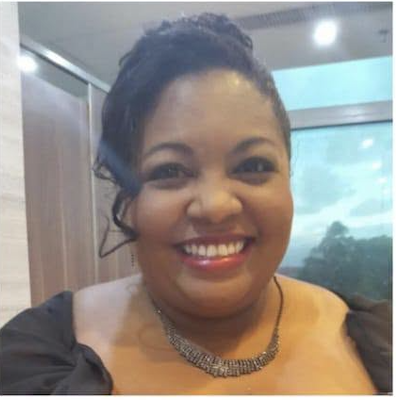
Long before becoming an accomplished historian, Dr. Collins-Gonsalves remembered herself as a somewhat shy student at St. Stanislaus College.
Despite her reserved personality, she embraced opportunities to participate in school life. She was involved in scouting, the Readers and Writers Club and elocution, activities that helped broaden her experiences and encouraged her personal development.
Her interest in writing also found expression at Saints through the publication by the Readers and Writers Club of a booklet of poems during her schooldays in which a few of her poems were included as well as the November 1995 issues of the St. Stanislaus Magazine.
Beyond the academic and extracurricular opportunities, she remembered the friendships she formed and the sense of belonging she experienced.
Her achievements at Saints included recognition as Best Overall Student in 1995, a distinction that reflected her academic accomplishments.
Looking back, she described the College as a wonderful grounding for her life.
Unlike those who discover their professional interests later, Dr. Collins-Gonsalves had always been drawn to history.
Her parents, Aubrey and Joan Collins played an especially important role in nurturing that interest. Through her family's involvement in the Guyana Heritage Society and her parents' encouragement of academic pursuits, she developed an appreciation for the importance of understanding the past.
That interest flourished at Saints, where she excelled in History and received recognition for her performance in the subject at CXC, attaining a grade 1 in 1995 and best history graduate award that year from her alma mater.
What began as curiosity encouraged at home gradually became the foundation of her life's work.
After leaving St. Stanislaus College, Dr. Collins-Gonsalves pursued a bachelor's degree in History at the University of Guyana.
Her professional journey included work at the CARICOM Secretariat before she continued her academic development at The University of the West Indies, where she obtained her doctorate in History.
Although her studies and professional responsibilities eventually took her beyond Guyana, she continued to value the academic foundation established at both St Stanislaus College and the University of Guyana.
Her doctoral studies expanded that foundation, exposing her to new perspectives, research opportunities and historical resources.
Working internationally further broadened her understanding of history and allowed her to investigate subjects across geographical boundaries.
Today, Dr. Collins-Gonsalves serves as the Founder and Managing Director of Historical Research International Inc. and is a Fellow of the Royal Historical Society in the United Kingdom.
Her scholarship encompasses economic history, business history, migration, heritage and the contributions of women in business.
She has authored several books and numerous other historical publications, establishing a body of work that examines individuals, institutions and communities whose experiences form part of a wider historical narrative.
Yet, despite the diversity of her research interests, she maintains that the fundamental process of historical investigation remains consistent wherever a historian works.
For Dr. Collins-Gonsalves, historical research begins with curiosity, but it cannot end there.
A historian must identify a subject, determine what is already known and locate the sources needed to investigate it.
Existing publications often provide an important starting point. They allow researchers to understand how a subject has previously been interpreted and identify questions that remain unanswered.
From there, historians may consult primary sources and archival records such as government documents, newspapers, correspondence, and other materials produced during the period under investigation.
Interviews can also provide valuable evidence, particularly when written documentation is incomplete.
Dr. Collins-Gonsalves explained that the challenge frequently lies in discovering where relevant records are held.
A single investigation may require consultation with several institutions, libraries and archives, sometimes across different countries.
Once the evidence has been gathered, the historian must examine the information critically and bring the different sources together to construct the most accurate account possible.
It is a process that requires patience and persistence. For Dr. Collins-Gonsalves, the search for a complete history of a particular subject never truly ends. New documents may emerge, previously inaccessible records may become available and familiar subjects can be understood in entirely new ways.
Few projects demonstrate this more clearly than her research into Iris de Freitas Brazao.
Among the most demanding investigations of Dr. Collins-Gonsalves' career was her research into Iris de Freitas Brazao, a pioneering Guyanese woman who became the first female barrister-at-law in the Commonwealth Caribbean.
The investigation began unexpectedly.
While researching the Portuguese community in British Guiana (now Guyana) and its involvement in business, Dr. Collins-Gonsalves encountered information about Iris' father, Manoel de Freitas, a wealthy Portuguese businessman. She later learnt from her father Aubrey Collins, about Manoel’s daughter Iris.
That suggestion eventually developed into a research project that would take thirteen years to complete.
Unlike some historical figures who leave behind extensive collections of personal documents, Iris had no known diaries or memoirs through which her life could easily be reconstructed.
Her education and experiences had taken her across several countries, including Guyana, Barbados, Canada, Wales and England.
As a result, Dr. Collins-Gonsalves had to access records located across three continents and five countries, research numerous sources, including British colonial records, newspapers from as early as the 1920s, University and school records, Official Gazettes of British Guiana, wills in England, census records among many other sources.
Her investigation led her to the records of institutions such as University of Oxford and the Honourable Society of the Inner Temple, housed in the Institute of Applied Legal Studies Library in England; the University of Toronto in Canada, and Queen’s College in Barbados among many others.
Some records were particularly difficult to obtain. She recalled waiting until 2019 before gaining access to one of the documents she needed.
The process required more than simply collecting dates and facts. It involved piecing together fragments of information to reconstruct the experiences of a woman whose achievements had not been fully documented.
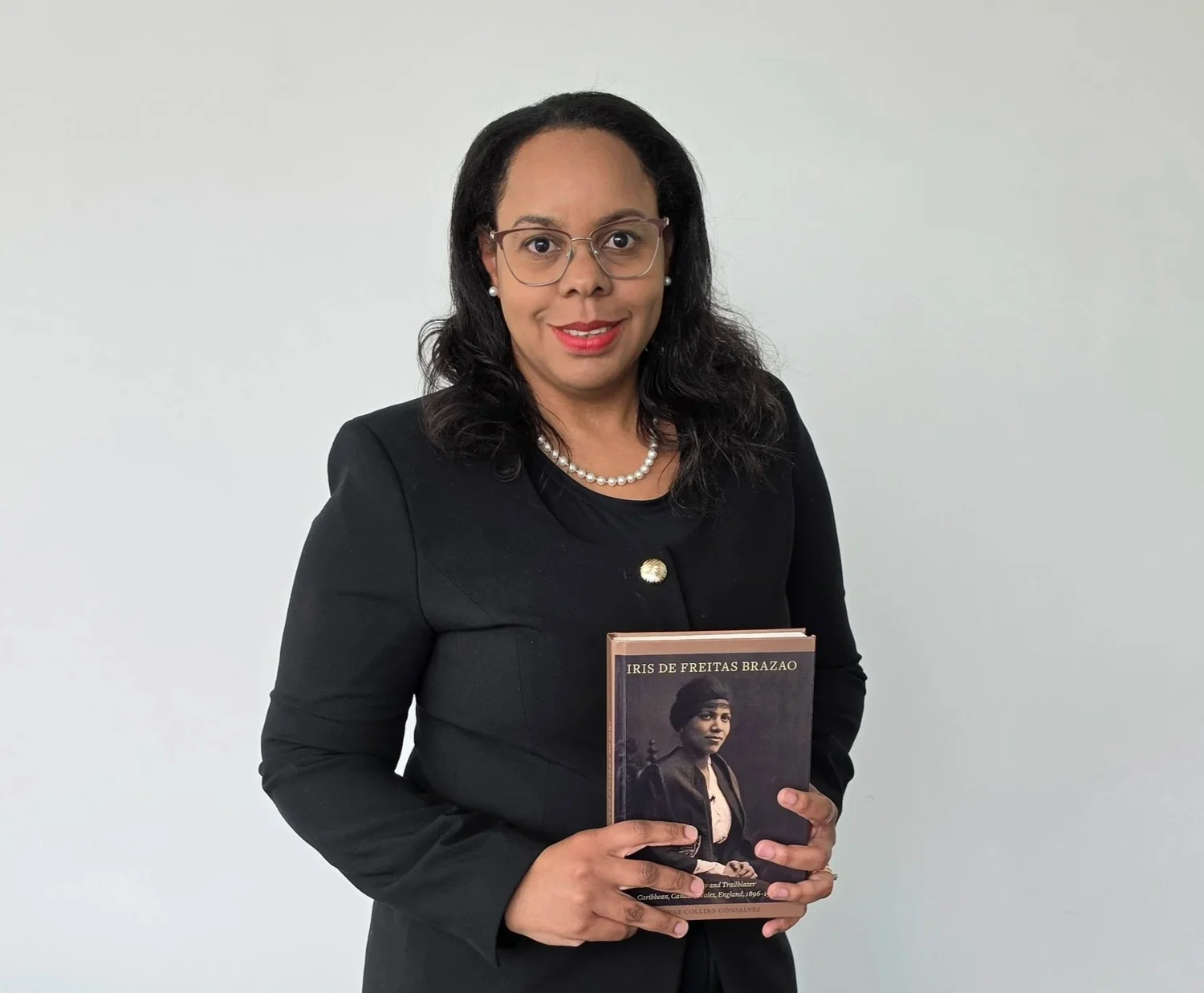
The research culminated in the publication of Iris de Freitas Brazao, Legal Luminary and Trailblazer: Caribbean, Canada, Wales, England, 1896–1989 in 2023.
Among the findings Dr. Collins-Gonsalves considers especially significant was evidence that Iris was the first woman of African descent to graduate from Oxford University in 1925.
For the historian, uncovering such information carries a profound sense of responsibility.
The discovery does not simply add another fact to an existing record. It introduces an important achievement to readers who may never have encountered that story.
Dr. Collins-Gonsalves described the opportunity to make such discoveries and share them with others as deeply humbling.
Her work demonstrates how historical research can restore recognition to individuals whose contributions might otherwise remain overlooked.
Another important area of Dr. Collins-Gonsalves' scholarship is the history of the Portuguese community in Guyana, particularly its involvement in business and entrepreneurship.
Her research examines how Portuguese immigrants and their descendants contributed to the development of commerce and economic activity.
This work led to the publication of her third book, The Portuguese in Business in Guyana 1835–1935: A History of Entrepreneurship, Expansion and Diversification in 2025.
Her interest in economic and business history also extends to the experiences of women in business, revealing how historical investigation can illuminate contributions that may not always receive adequate attention.
These projects reflect her belief that history is not confined to political developments or major national events.
The history of businesses, communities, families and institutions can be equally important in understanding how societies develop.
Indeed, it was while conducting research on other subjects that Dr. Collins-Gonsalves repeatedly encountered information about a familiar institution: St. Stanislaus College.
Dr. Collins-Gonsalves' interest in researching St. Stanislaus College developed gradually.
While examining archival material for other projects, she would occasionally discover references to the College, including information she had not previously encountered in school publications.
Intrigued by these discoveries, she began collecting the material.
Over time, the information accumulated, revealing aspects of the institution's past that deserved closer examination.
Her family's involvement in the College has a long history. Her great-uncle, Jocelyn Greaves, was a student at the College around the 1910s, while her father Aubrey Collins and uncles Milton and Carlton and Justice Lindsay Collins, also all attended in the 1930s and 40s. As well as many cousins and siblings. Justice Lindsay Collins also served as President of the St. Stanislaus College Old Students Association in 1972.
Dr. Collins-Gonsalves also maintained an active relationship with her alma mater after completing her education. During the early 2000s, she served on the Saints Association Board, contributing to the alumni community and continuing her involvement with the institution that had played such an important role in her development. She is currently a member of the Toronto alumni chapter.
Her connection to Saints was therefore both personal and professional. Beyond participating in its alumni community, she also devoted scholarly attention to documenting its past.
In April 2001, she presented research on the history of St. Stanislaus College at a meeting of the Guyana Heritage Society in celebration of the 135th anniversary of the school.
As the College approached its 160th anniversary, she saw an opportunity to develop the historical information she had collected into a more extensive account.
However, her investigations also made her increasingly aware of how much more remains to be discovered.
For Dr. Collins-Gonsalves, documenting the College's history is not a task that can be considered complete simply because an anniversary has arrived.
It is an ongoing process of investigation, interpretation and preservation.
One of the discoveries that particularly interested Dr. Collins-Gonsalves concerned the teaching of Portuguese at St. Stanislaus College during the 1880s.
At that time, many students came from Portuguese families or were of Portuguese descent.
The community's strong connection to Roman Catholicism was also significant in the institution's early development.
Some students spoke Portuguese, while certain families wished to preserve the language among their children.
Portuguese was therefore taught at the College, reflecting the linguistic and cultural heritage of aspects of the community it served.
Dr. Collins-Gonsalves also noted that Saints would later become one of the early schools to offer Portuguese at the CSEC level in 2013.
For today's students, such discoveries provide a glimpse into a version of the College that differs considerably from the institution they know.
They reveal how the school has responded to changing educational needs and how its history reflects broader developments within Guyanese society.
More importantly, they demonstrate why historical records must be preserved.
Without them, details that once formed part of everyday school life can gradually disappear from collective memory.
Dr. Collins-Gonsalves acknowledged that her understanding of St. Stanislaus College has changed significantly since her schooldays.
As a student, her attention was naturally focused on classes, friendships and extracurricular activities.
She experienced Saints primarily through the opportunities and relationships that shaped her daily life.
As a historian, however, she has developed a broader understanding of the institution.
She now recognises the College as part of a much larger story involving generations of students, teachers, alumni and individuals who have contributed to Guyana and communities around the world.
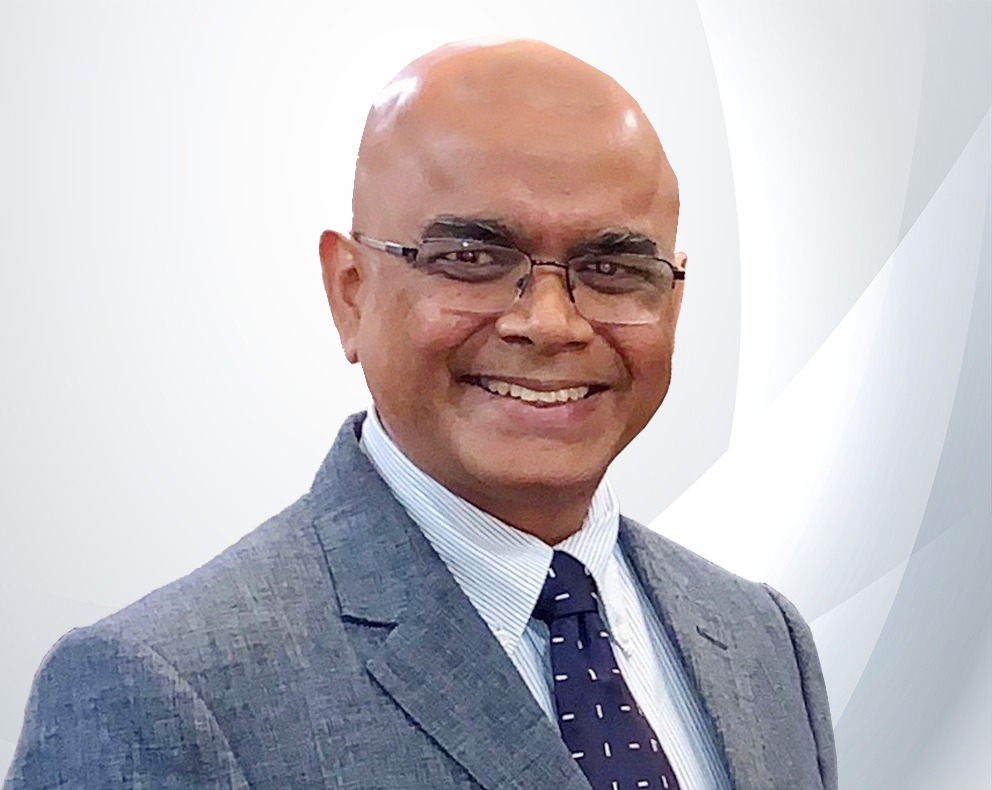
She reflected on the accomplishments of former students, including President Dr. Mohamed Irfaan Ali, and the many alumni who have continued to support the institution.
For her, the College's history is not simply a record of buildings, examinations or school activities.
It is also the history of the people who passed through its classrooms, the contributions they made and the relationships they maintained with their alma mater.
Her research has deepened her appreciation of those connections and the influence Saints has exercised beyond its school grounds.
It has also reinforced the importance of preserving the contributions of teachers, former students and others who helped shape the institution.
One of the most meaningful moments in Dr. Collins-Gonsalves' interview came when the discussion turned to the work being undertaken by the St. Stanislaus College Journalism Club.
Asked how student journalists could help preserve the memories of important individuals connected to Saints, she explained that the stories they were recording would themselves become part of the historical record.
Future historians may use these interviews as sources when researching the College and the people associated with it.
She emphasised that responsible historical investigation requires examining multiple sources, including oral accounts alongside written documents and archival records.
Her response gave the Journalism Club's anniversary initiative a significance extending beyond the publication of individual features.
Each interview records memories and experiences that may otherwise be lost.
The recollections of former students provide insights into the College's changing traditions, educational environment and influence across generations.
Together, these accounts can contribute to a broader understanding of Saints' history.
For the students conducting the interviews, the experience therefore represents more than an opportunity to practise journalism.
They are participating in the preservation of their institution's heritage.
The articles they write today may become the documents consulted by researchers many years from now.
For Dr. Collins-Gonsalves, one of the challenges facing historical research in Guyana is the limited digitisation of archival records.
Many documents remain accessible only through physical collections, making research more difficult and increasing the importance of protecting original materials.
She believes that history must be continuously researched, documented and made available to future generations.
Through her publications, she hopes readers will develop a fuller understanding of the individuals, communities and subjects she has investigated.
She also hopes that more students from St. Stanislaus College will consider careers in history.
In her view, the subject offers opportunities far beyond teaching.
Historical research intersects with business, art, medicine, engineering and numerous other fields.
She noted that every profession and area of study has a history, and historians can contribute by examining how knowledge, practices and institutions have developed over time.
Her own career, spanning economic history, business history, biographies and heritage research, illustrates the breadth of possibilities available.
For students who enjoy investigating questions, examining evidence and discovering previously unknown information, history can provide a rewarding path.
When Dr. Joanne Collins-Gonsalves reflects on her journey, the connection between her early experiences and her life's work becomes clear.
The shy student who participated in scouting, elocution and the Readers and Writers Club developed into a scholar whose research has taken her across countries and through archives containing stories waiting to be recovered.
The interest in history nurtured by her family and strengthened at Saints became the foundation of a career devoted to documenting people, communities and institutions.
Her investigations have brought attention to pioneering individuals, explored the contributions of the Portuguese community and expanded knowledge of Guyana's historical development.
Her service on the Saints Alumni Association Board and her research into the College's past also demonstrate that her connection to Saints has continued well beyond her years as a student.
As St. Stanislaus College celebrates 160 years, Dr. Collins-Gonsalves reminds us that an institution's legacy cannot be measured only by the number of years it has existed.
It must also be understood through the experiences of its students, the contributions of its teachers and the achievements of those who carried its influence into the wider world.
For the Journalism Club, her reflections offer a particularly important lesson.
The stories being collected during this anniversary year are not simply memories to be enjoyed in the present. They are contributions to a historical record that future generations may depend upon.
For a historian who has dedicated her life to recovering stories from the past, perhaps one of the most meaningful contributions she can make is helping ensure that the story of Saints continues to be told.